
The Social Dilemma is a docu-drama about the problems and issues from behind the scenes of social media as a whole. It details how the outcome was not the intent when created. The majority of the film is explained through interviews with ex-social media employees, doctors, and professors. To ensure the audience has a better understanding of what is being told, there is dramatization showing artificial intelligence (AI played by Vincent Kartheiser) and the effects of social media within one family.
Well! This film was an eye-opener to this social media user. I previously heard rumors about Facebook collecting data for this reason or that reason. I previously heard conspiracies about Facebook being FedBook, as to say it is the FBI’s way of obtaining information from Americans to be used against them. While any or none of that may be true, one thing is for certain; Facebook is collecting data gathered from its users. According to The Social Dilemma, all social media platforms are collecting data gathered from their users.
So, the new question is why? Why are we users being spied on so diligently? One of the best answers came from Aza Raskin, former Firefox Mozilla employee, and inventor of the Infinite Scroll. He says, “Data isn’t being sold. They build models that predict our actions. Whoever has the best model, wins.” The models he’s referring to are the AI models. It seems the goal is to improve AI the best way possible so AI will be the true know-it-all and go-to of society.
Since “Social Media is a drug,” says Dr. Anna Lembke, Medical Director of Addiction Medicine, Stanford University School of Medicine, it makes sense to gather our social media data. We are drawn, no, addicted to giving what we don’t realize we’re giving. Shoshana Zuboff, Ph.D., Harvard Professor Emeritus said that social media is, “a marketplace that trades in Human Futures. We now know we can affect real-world behavior and emotions without ever triggering the users’ awareness. They [the users] are completely clueless.” She calls this, “Surveillance Capitalism” and wrote a book of a similar title.
Surveillance Capitalism – Let’s break that down!
- Surveillance: noun: the monitoring or behavior, activities, or information for the purpose of information gathering, influencing, managing, or directing.” “Influencing, managing, or directing.” Three words to remember.
- Capitalism: noun: an economic system based on the private ownership of the means of production and their operation for profit.
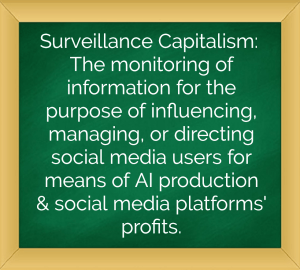
Pulling from both definitions as it relates to the message from The Social Dilemma, I created my own definition to help me understand why Dr. Zuboff chose such a phrase:
Now, you may say, “But social media sites are free. There is no profit to be made. The user doesn’t pay anything for the companies to benefit.” Well, thanks to The Social Dilemma‘s AI and family dramatizations, here’s what we learned about social media’s monetization factor. There are three major components working together to create every user’s AI persona. The components are Growth, Engagement, and Advertising. Actor Vincent Kartheiser (best known to me for his role in the tv series, Mad Men), plays all three components to build the AI version of Ben, the son.
After Growth and Engagement get Ben to do a few things, Advertising says they auctioned Ben off to “468 ad bidders.” Then Advertising hits a red button and yells, “We sold Ben at 3.262 cents.” This happens a few times throughout the film where Advertising says how much they made from the ad bidders per action. “Our attention is being sold to the advertisers,” Justin Rosenstein, former Facebook and Google engineer and co-inventor of Facebook’s “Like” button.
Quick math – Millions of Engagement plus millions of Advertising per day, multiplied by various bidding amounts equals Growth and social media being a billion-dollar industry. Capitalism!
According to the former social media platform employees interviewed, none of this was the intent when they started working on what they worked on or created what they created. Since time and intentions changed, many of these former employees had “ethical concerns,” says Joe Toscano, former Google Design Consultant, to where they left the companies. Tim Kendall was the former Director of Monetization at Facebook who suggested the advertising model. He also mentioned his suggestion wasn’t meant to be the outcome it’s become. Many of the former employees interviewed are working in other tech-areas trying to find a better way to combat what’s happening. Tristan Harris, former Gmail Design Ethicist seems to be the leader of the movement. He was dubbed, “The closest thing Silicon Valley has to a conscience,” in The Atlantic and so far, The Social Dilemma is proving The Atlantic right. Some of the former employees are working with Tristion to further his efforts.
While this film was more informative than anything, I advise every social media user to sit through all 90 plus minutes. It’s quite educational and will make you question the next thing you choose to share on social media. It may even make you scale back your social media usage. Though I gave away a lot, I left a lot to be seen and learned. I hope you watch it!
 Writing Waves